

Notice of Ausdance National Annual General Meeting — 24 June 2026
The Australian Dance Council — Ausdance National, will hold its Annual General Meeting as follows:
Date: Wednesday 24 June 2026
Time: 4.30pm AEST.
Place: Via Zoom (see link on Agenda)
We look forward to welcoming members to the AGM and providing an update of Ausdance National’s activities, including details of submissions made douring the 2025 calendar year, financial statements, election of Board members, and an update on the Peggy van Praagh Choreographic Bequest and Keith Bain Travelling Fellowship.
Please RSVP to Ausdance National by COB Monday 22 June 2026. If you are unable to attend, please send your apology and/or complete and return the Proxy Form (below).
To participate, you must be a financial member of your state/territory or an Honorary Life Member. Proxy forms are due no later than 24 hours before the meeting.
Board nominations close 16 June 2026
Members who RSVP their attendance will be sent the AGM Zoom link and Audit & Financial Report before the meeting. We look forward to meeting with you on Wednesday 24 June.
Board nomination form (to Ausdance National by 16 June 2026)
Nominate a proxy (to Ausdance National 24 hours before the meeting),
2026 International Dance Day Message
In 1982 the Dance Committee of the International Theatre Institute founded the International Dance Day (IDD) to be celebrated every year on the 29 April, the birthday of Jean-Georges Noverre (1727-1810), creator of modern ballet.
The intention of the IDD Message is to celebrate dance, revel in the universality of this art form, across all political, cultural and ethnic barriers, and bring people together with a common language – dance.
Every year a message from an outstanding choreographer or dancer is circulated throughout the world. The author of the message is selected by the International Dance Committee of ITI and the Executive Council of ITI. The message is translated into numerous languages and circulated globally. World Dance Alliance is a member of the ITI Dance Committee.
This year the Dance Committee of the ITI has selected Canadian choreographer Crystal PITE to provide the 2025 Message.
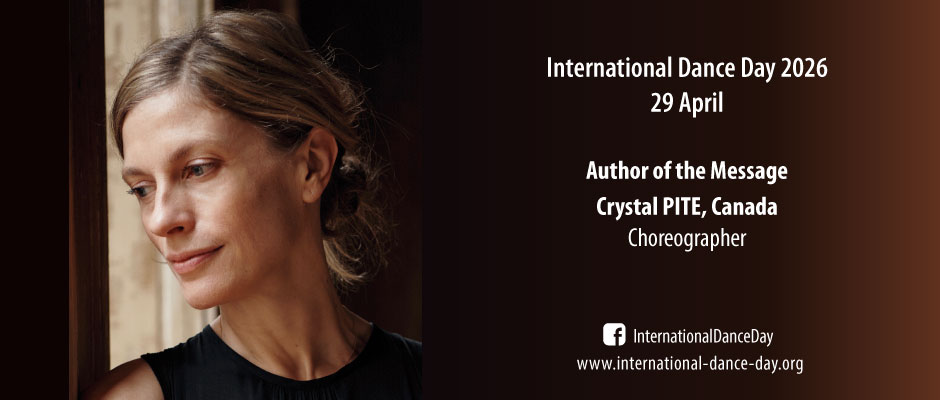
Humans move – our arms reach out, our knees collapse, our heads nod, our chests cave in, our backs arch, we jump, we shrug, we clench our fists, we pick each other up and push each other away. This is language as much as it is action.
This is what the body has to say about need, defeat, courage, despair, desire, joy, ambivalence, frustration, love. These images flash with meaning in the mind because we have felt these things so purely in the body – we have been moved.
We are dancers, all of us. Life moves us; life dances us. Ephemeral as breath, concrete as bone, a dance is made of us. We sculpt space. We write with our bodies in a wordless language that is deeply understood. We grace the space within and around us when we dance.
Like life, a dance creates and destroys itself in every moment. Like love, it is beyond reason. I like to think of the body as a location; a place where being is held and shaped. When we dance, we are profoundly engaged in being there.
I’m writing this in early 2026, when there seems to be no end to the oppression, upheaval and suffering in our world. Daily, as we witness the horror of what humans are capable of doing to each other and the machinery of power that funds and fuels unspeakable violence to people and planet, dance feels like a facile, useless response. It’s hard to imagine what a dance artist can do in a world that so badly needs radical change and healing.
And yet – art, like hope, is a form of love. Defiantly generative in the face of desecration, art is a solvent for the calcifying mind and a balm to heal it. Art is a vessel to hold us while we grapple with questions – together – in a way that is different from news, different from documentary and education, different from opinion and social media, different from activism and protest, but not incompatible.
Through creativity, we accumulate resistance and hope through small acts of courage, curiosity, kindness and collaboration. In dance, and in dance-making, we find proof that humanity is more than our latest heartbreaking global failure.
But dance needs no justification, no explanation. It’s made of us yet owes us nothing. It only needs to inhabit a willing body. From that location, it can translate the ineffable; acting as an intermediary between us and the unknown.
We are moved by these vanishing traces of beauty in the present moment. And as we embody both the dance and its disappearance, we are reminded of our impermanence. At the same time, if we are paying attention, dance will give us an occasional glimpse of the soul.
International Young Choreographers Project 2026
Australian choreographer Tegan Jeffrey-Rushton to partcipate in 2026 IYCP
The International Young Choreographer Project (IYCP) is held in southern Taiwan in July/August and is hosted by World Dance Alliance Asia–Pacific Taiwan chapter.
Ausdance National called for applications in February for this year's IYCP, and 16 excellent proposals were received.
Each application was carefully considered by a small panel, and Sydney choreographer Tegan Jeffrey-Rushton was the artist whose name went through to organisers in Taiwan, for consideration as one of only eight to participate from the Asia–Pacific region. We are delighted to announce that an Australian choreograopher has again been included in the final eight.
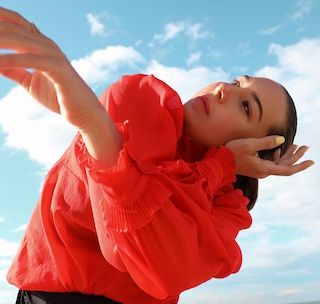
Tegan will travel to Kaohsiung where the choreographers will work with selected dancers from Taiwan for three weeks, culminating in two public performances in that city. The program 'highlights the diversity of dance in both styles and cultures, and how local and international choreographers perceive their daily lives and the world'.
Congratulations Tegan, and thanks to all the applicants whose work will continue to influence and be influenced by dance in Australia.
TDCA advocates for Dance Education across all sectors of the community
The Tertiary Dance Council of Australia (TDCA) is advocating for dance education and its role in society at all educational levels, from early childhood through to tertiary education and beyond.
By examining these connections and making them visible, we advocate for a more integrated, holistic approach to dance education policy and practice.
Just as the full picture emerges when dots are joined visually, the true value of dance education becomes apparent when we connect its impacts across social, emotional, cognitive, cultural, therapeutic, and professional domains.
In this paper, entitled Joining the Dots: Advocating for the Role of Education Across All Sectors of the Dance Community, the TDCA presents comprehensive evidence demonstrating the significant positive impacts of dance education across mutiple domains of Australian society.
Drawing on a substantial body of international and Australian research, we establish that dance education enhances socio-emotional competence and critical thinking skills in children and adolescents, providing them with essential tools for personal development and academic success.
Dance education improves mental health outcomes and general wellbeing across various demographics, offering therapeutic benefits that address contemporary health challenges. Additionally, dance provides unique cultural and healing benefits for First Nations communities, supporting cultural continuity and addressing intergenerational trauma.
—Dr Peter Cook, USQ
Chair, TDCA
Ausdance submission to the Senate Environment and Communications References Committee
Inquiry into the National Cultural Policy 2025
Late last year Ausdance made a submission on behalf of the national Ausdance network in support of Australia’s dance ecosystem—artists, educators, Cultural dance leaders, companies, studios, festivals, community organisations and allied health partners across metropolitan, regional and remote Australia.
We welcomed the Committee’s targeted interest in (a) tax reform and productivity, and (b) emerging technologies including artificial intelligence (AI).
Our positions are grounded in prior Ausdance submissions (national, state and territory), sector research on valuing the arts, First Nations consultations, and lived experiences of dance professionals, workers, practitioners and small businesses.
The Ausdance national network also applauds and supports ANA’s (A New Approach) “Imagine 2035” call for a National Arts, Culture & Creativity Plan and urges its adoption alongside the National Cultural Policy. Such a plan should include a Strategy-on-a-Page, clear outcomes and measurements, and be underpinned by ongoing collaborations across all levels of government (federal, state, territory, local) and with First Nations leadership.
In recognising culture’s role in addressing major societal challenges we recommend policy settings and funding programs that explicitly allow for arts responses with social / environmental purpose, not only economic outputs.
Read the submission.
Prepared for Australian Dance Council, Ausdance Inc (National)
Email Julie Englefield: Tel. 0426296050
WITH
Australian Dance Council, Ausdance (ACT) Inc
Australian Dance Council, Ausdance (QLD) Inc
Australian Dance Council, Ausdance (SA) Inc
Australian Dance Council, Ausdance (VIC) Inc
Australian Dance Council, Ausdance (WA) Inc
International Young Choreographers Project 2026
Applications from emerging Australian choreographers are now being called for this international opportunity.
Ausdance is calling for applications for the 2026 International Young Choreographer Program.
The IYCP has been providing young choreographers with this invaluable artistic and cultural experience since 1999.
Closing date is very tight this year – 18 February 2026.
About the International Young Choreographer Project
The International Young Choreographer Project (IYCP) is held in southern Taiwan in July/August and is hosted by World Dance Alliance Asia–Pacific Taiwan chapter. Eight choreographers from the Asia-Pacific region are chosen by WDA Asia Pacific (WDAAP) to attend. Victorian choreographer Callum Mooney was selected for the last IYCP. He said:
IYCP was an incredible opportunity for creative growth and cultural exchange. The dancers I had for my development were very special movers and people, and I have made long-term connections with them. There was a performance outcome of my short work equilibrium that was presented for IYCP in Kaohsiung (photo below by Tsun-Yang TSUI).
The cultural exchange of the different choreographers from different parts of the Asia–Pacific region was beautiful. I learned a lot and shared many amazing moments. I have luckily been asked by the organisers to come back to Taiwan to create and teach for the school in the coming years.
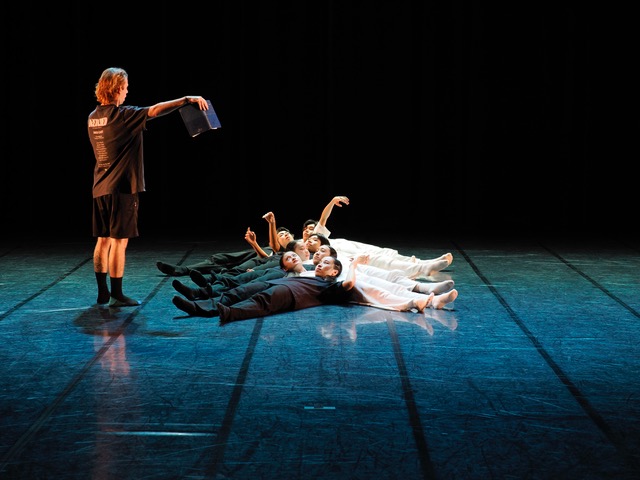
Participants are selected from a list of young choreographers recommended by World Dance Alliance country chapters (Asia Pacific, including Australia, the Americas and Europe), based not only on their choreographic work, but also on their ability to meet the challenges of working in a foreign country with unfamiliar dancers and culture, and their potential as a significant contributor to dance in the future.
The selected choreographers work with selected dancers from Taiwan. The three-week process of developing new works with local Taiwanese dancers concludes with two performances. The program highlights the diversity of dance in both styles and cultures, and how local and international choreographers perceive their daily lives and the world.
Participants must fund their own travel to Taiwan. However, in addition to a $US800 grant, accommodation, local transportation, dancers, studios, publicity, production and office assistance are included.
Australian applicants must be members of Ausdance (find your local Ausdance).
Information for applicants
Application forms are available here, and should be returned to Ausdance National by 18 February.
In addition to contact information, applicants will be asked these questions:
- What you would gain from a professional experience such as this?
- Why would you like to work in Asia?
- A brief concept of your proposed work.
- A 200-word biography and a resume/CV.
Closing date: 18 February 2026.
Notice of 2025 Ausdance National Annual General Meeting
The Australian Dance Council — Ausdance National, will hold its Annual General Meeting as follows:
- Date: Monday 16 June 2025
- Time: 6:00pm AEST.
- Place: Via Zoom (distributed Friday 13 June)
We look forward to welcoming members to the AGM and providing an update of Ausdance National’s current activities, including presentation of the new Constitution, the result of a review and extensive consultation with the Ausdance Network.
The Constitution has been revised to align with the new 2023 ACT Model Rules and will enable greater collaboration between the Ausdance Network and Ausdance National.
Please RSVP to Natalie Allen by COB Wednesday 11 June 2025. If you are unable to attend, please send your apology and/or complete and return the Proxy Form.
Members who RSVP their attendance will be sent the AGM Zoom link and Audit & Financial Report on Friday 13 June. We look forward to meeting with you on Monday 16 June.
Ausdance National Council – 2025 call for nominations
The Ausdance National Annual General Meeting will be held via Zoom on Monday 16 June 2025 at 6.00pm AEST.
Nominations for four Executive positions on the Ausdance National Council (President, Vice-President, Secretary and Treasurer) are now open, and must be made on a nomination form obtainable from the National President, Jacob Williams, by Friday 23 May 2025.
The form must be signed by a nominator and a seconder, each of whom is a member of the association. Nominees must also be Ausdance members.
1. General information
In accordance with Ausdance National's Constitution, all National Council roles are volunteer positions. Four positions are Executive positions, and the other five are filled by State & Territory Directors, as set out in the organisation's new Constitution. At present the organisation is not staffed, but the National Council acts as national headquarters and provides leadership on national matters.
National Council members are expected to work towards achieving the vision and mission of the association, but there is no obligation for them to carry out duties other than those required by the Associations Incorporation Act 1991 Australian Capital Territory,
Currently, the National Council meets quarterly online, and between meetings its board members carry out both governance and operational duties.
2. Responsibilities of Ausdance National
The National Council is responsible for overseeing:
- Effective communication and collaboration with the Ausdance network and the membership.
- National dance advocacy policies and programs on behalf of the dance community.
- The financial management of Ausdance National.
- The sourcing of funds for Ausdance National’s activities.
- Reporting to The Australian Charities and Not-for-profits Commission (ACNC).
3. National Council membership
The National Council seeks a composition of individual professionals and cultural leaders that is reflective of the diversity of the wider community. The National Council values self-determination of First Nations Peoples and encourages Aboriginal and Torres Strait Islander people to nominate.
To service the current mission of the association, candidates who have recognised knowledge, skills, and experience in two or more of the following areas will be highly regarded:
- Dance
- Advocacy
- Health and wellbeing
- Education
- Justice, equity and inclusion
- Accountancy
- Law
- Arts and Cultural Management
- Marketing
- Public relations & communications
- Corporate governance
- Information technology
- Human resources
- Business and systems development
- Strategic planning and change management
- Policy development
- Legislative Processes
Ausdance National is actively committed to helping to build a safer and more inclusive dance sector, and we seek individuals for the National Council who:
- Respect, acknowledge and value First Nations Peoples and Cultures.
- Are committed to advocating for equity, anti-discrimination and intersectional diversity in the Australian dance environment.
- Prioritise and support safe spaces for such discussions.
- Value the unique capacity of dance for cross-cultural exchange, knowledge-sharing, artistic expression, healing and storytelling.
- Will promote and engage in respectful communication, interactions and behaviour across all platforms throughout the dance community.
4. Nomination process
Along with your nomination form, please outline your skills, knowledge and experience relevant to dance, governance, and/or the skills outlined above.
The following selection criteria will also be considered for nominated Executive positions:
- A commitment to the development of dance in Australia.
- A commitment to serve the mission of Ausdance National.
- Proven ability to think strategically in a changing and dynamic environment.
- High-level skills, knowledge and experience that will significantly contribute to the good governance and future vision of Ausdance National and the Ausdance network.
Based on consideration by the National Council, a shortlist of the candidates who fulfil the board requirements will proceed to member vote at the AGM. Nominees must be members of Ausdance.
Where multiple candidates are recommended by the National Council for a position, these candidates will be selected by election at the AGM.
Appointed positions are for a two-year term.
5. Contact
Please contact National President Jacob Williams for further information and to request the nomination form. Nominations must be returned to the President by Friday 23 May.
2025 International Dance Day Message
In 1982 the Dance Committee of the International Theatre Institute founded the International Dance Day (IDD) to be celebrated every year on the 29 April, the birthday of Jean-Georges Noverre (1727-1810), creator of modern ballet.
The intention of the IDD Message is to celebrate dance, revel in the universality of this art form, cross all political, cultural and ethnic barriers, and bring people together with a common language – dance.
Every year a message from an outstanding choreographer or dancer is circulated throughout the world. The author of the message is selected by the International Dance Committee of ITI and the Executive Council of ITI. The message is translated into numerous languages and circulated globally. World Dance Alliance is a member of the ITI Dance Committee.
This year the Dance Committee of the ITI has selected Latvia/USA dancer Mikhail BARYSHNIKOV to provide the 2025 Message.

"It’s often said that dance can express the unspeakable. Joy, grief and despair become visible;
embodied expressions of our shared fragility. In this, dance can awaken empathy, inspire
kindness, and spark a desire to heal rather than harm.
"Especially now—as hundreds of thousands endure war, navigate political upheaval, and rise in
protest against injustice—honest reflection is vital. It’s a heavy burden to place on the body, on
dance, on art.
"Yet art is still the best way to give form to the unspoken, and we can begin by
asking ourselves: Where is my truth? How do I honour myself and my community? Who do I
answer to?"
Ausdance submission to the National Office for Child Safety
The national Ausdance network has made a landmark submission for Dance to the National Office for Child Safety in response to its Child Safety Annual Reporting Framework consultation paper.
It is not possible to overstate the urgency expressed by Ausdance members to comprehensively address the issue of child safety. The overwhelming response of the dance sector – following substantial consultation over more than four years – is that it should be better regulated so the safety of children in organisations is improved.
The national Ausdance network has championed ‘Safe Dance’ since 1990. Currently, improving safety in dance environments, particularly for children, is a key priority for the network.
The National Office for Child Safety’s proposed child safety annual reporting framework aims to encourage and support organisations through capability building to implement good practice child safety policies and processes to embed cultures that prioritise the best interests of all children.
Ausdance holds continuous consultations on the subject of child safety. A survey of members to address this consultation paper was circulated nationally in December with substantial sector participation.
Ausdance 2025 Pre-Budget submission
Dance is more than entertainment—it’s essential!
From improving mental health to creating jobs, dance impacts millions of Australians. Yet, funding falls short.
Ausdance has submitted its case to the Federal Government ahead of the 2025 Budget. We’re asking it to prioritise direct investment in services and support for First Nations dance practitioners, better safety in dance, stronger arts education, affordable and accessible venues, and fair pay for dance professionals.
If we want to see a thriving, inclusive, and sustainable dance sector, investment must be a priority in this Budget. Read our pre-Budget submission for details.
Clarification about status of Award pay rates for dance teachers
Ausdance identifies improved standards in the workplace and increased sector knowledge of employee rights and employer obligations.
Another identified priority is increased professional development/training and support for small businesses and organisations to improve child safety, safer workplaces, safer spaces, safer bodies and minds in the whole dance community.
This article was prepared by Ausdance Qld, and is designed to provide clarification about the status of Award pay rates for dance teachers.
Fair Work Commission
The Fair Work Commission is Australia’s workplace relations tribunal and registered organisations regulator. It makes awards, approves enterprise agreements and helps resolve issues at work.
It has a ‘small business hub’ which specifically answers questions about current issues such as fixed term contracts, ‘right to disconnect’ , family and domestic violence provisions and more.
Employees/ Contractors
The difference between an Employee and a Contractor can be complicated; it is an area of the law that is not set in stone and the definitions used have recently changed.
A contractor is sometimes also called an ‘independent contractor’ or a ‘sub-contractor’, however these terms all have the same meaning. The critical differences between an employee and independent contractor are:
- an employee serves in your business, and performs their work as a representative of your business;
- a contractor provides services to your business and performs work to further their own business.
As a general rule of thumb:
- a person is an Employee if the employer determines where/when the worker (dance teacher) works, and if the employee is required to perform work as a representative of the employer’s business, is paid by the hour or has their pay determined by the employer, and cannot delegate their work to someone else;
- a person is a Contractor if the worker chooses when/where and how the work is done, performs work to further their own business, is generally contracted to achieve a specific result, and is able to subcontract to another person of their choosing.
The awards cover employees and are governed by the Fair Work Commission.
The Dancers Australia Industry Code of Practice covers both employees and contractors, and is governed by the Media, Entertainment and Arts Alliance (MEAA).
All workers must be paid superannuation on top of their fee or wage (i.e. not taken out of their wage), regardless of whether they are an Employee or a Contractor.
The ‘Modern Award System’
The Modern Award System was created in 2009, to provide all Employees in each industry a standard set of minimum wages and conditions. These include:
- common entitlements that included in all awards – eg. a 25% casual loading, a minimum engagement (usually 3 hours), and, from this year, new entitlements, such as the right to change from casual to full time or part time employment, and the ‘right to disconnect’; and,
- specific entitlements that only apply to that industry.
Live Performance Award
The Live Performance Award covers Employers in the live performance industry and their employees who fit within the classifications of the Award.
Regardless of whether the performance, rehearsal, workshop, presentation, or concert takes place in front of an audience or is recorded, the ‘live performance industry’ means:
- producing (pre and post production), staging, lighting, audio and audio/visual, presenting, performing, administrating, programming, workshopping, set and prop manufacturing; or,
- undertaking live theatre, performance art, operatic, orchestral, dance, erotic, variety, revue, comedy, multi-media, choral, or musical performances, productions, presentations, rehearsals, or concerts;
An important feature of this Award is the ‘definition’ of a performance: “Performance means a performance given by Employees before an audience for which the Employer receives a payment or other benefit.”
This Award also includes specific scheduling and rostering clauses, allowances and per diems, rehearsal rates, penalty rates, and other entitlements that are unique to the live performance industry.
Currently dance teachers (employees) are not covered by this award. Choreographers are also not covered by this Award.
Fitness Industry Award
Historically, the dance teaching industry has accepted that dance teacher Employees are covered by the Fitness Industry Award. The current minimum pay rates range from $12.90 for a junior casual teacher to $32.18 and do not provide for specific skills, dance teaching experience or criteria.
Since 2020, dance teacher and studio owner members have regularly informed Ausdance QLD (in consultations) that the rates and associated requirements/provisions are not appropriate for dance teachers. The Union has taken the position that the Fitness Industry Award is not appropriate for dance teachers, and that applying this Award can result in underpayments.
The Media, Entertainment and Arts Alliance (MEAA / the Union)
This is the Union for workers across the media, entertainment, and arts industries, including all dance professionals, actors, musicians, technical crew in theatres, film, and television, journalists, and more.
MEAA was registered on May 18, 1992 as the Media, Entertainment and Arts Alliance, formed from the merger of three unions: the Australian Journalists Association, Actors Equity of Australia, and the Australian Theatrical and Amusement Employees Association. The history of these three unions goes back to the early 1910s, and the current structure of MEAA reflects those origins.
In 2006, a fourth section was created when the Symphony Orchestra Musicians Association joined the Alliance. In 2021, MEAA added another group, Dancers Australia, in recognition of dance-specific workplace issues which impact the working lives, health and careers of dance professionals.
Dancers Australia
Dancers Australia is the union for dancers, dance teachers, and choreographers in Australia. It is led by the Dancers Australia National Committee – a group of dancers, dance teachers, and choreographers from across the country who are pushing for fair wages and safe workplaces for all workers in the dance industry. Dancers Australia is part of MEAA.
The Committee’s first Strategic Plan encompasses four critical components:
- 2022 – undertake research into dancer and choreographer rates;
- 2023 – approve and commence enforcement of an Industry Code of Practice;
- 2024 – undertake research into dance teacher rates; and,
- 2025 – approve a specific Dance Teachers section as an addition to the Code.
Dancers Australia – Dance Industry Code of Practice 2024-2025
This is a voluntary Code of Practice, similar to those in media and advertising. If you are a member of MEAA, or you are a company who is a signatory to the Code of Practice, you are legally bound to comply with this Code.
A new Code is released on 1 July each year, which includes an annual wage increase and any new or updated entitlements.
The Code currently includes rates and workplace conditions for:
- dancers – with the lower range of rates mirroring the Award, and higher range of rates mirroring what is actually paid by reputable companies in the industry; and,
- choreographers – a rate for a choreographer’s time, plus a ‘fee’ for the choreographic product they create.
In 2025, MEAA will add a new Schedule of Dance Teacher Rates. This will include:
- A low tier of rates that need to fit within the rates already in the Award – a minimum of $25.41 per hour, a maximum of $39.69 per hour, for dance teachers with 7 years’ or less experience;
- A high tier of rates that need to reflect what is actually paid in the industry – starting at $40 per hour for dance teachers with more than 7 years’ experience; and,
- A set of workplace conditions – such as penalty rates, overtime, payment for supervising children, allowances/per diems, sick/injury leave, safety protections, etc. – that adequately remunerate for skills and experience, cover the expenses that dance teachers have, match the cost of living, and ensure dance teachers are provided with a safe workplace.
Current situation and next steps
The Fair Work Commission regularly reviews awards as part of the Modern Award Review to ensure they’re fit for purpose and to update rates and conditions. In 2023/4 a targeted review has been undertaken to look at which awards cover workers and the minimum standards in the arts and culture sector.
The final report for the public part of this review was released in July. The Fair Work Commission elected to make minimal changes to the Live Performance Award based on the consensus of ‘interested parties’. Another priority of the Modern Awards Review is to ensure no-one ‘falls through the gaps’ as Employees.
MEAA, led by Dancers Australia, identified to the Commission that choreographers and dance teachers are falling through the gaps in the awards. They have identified this through member consultation and industry surveys. Ausdance QLD and the Ausdance National network have also provided data, and will continue to seek input from our members to inform any changes.
As part of the Modern Award Review process, MEAA proposed that the Live Performance Award be updated to cover these two Employee categories. In the Commission’s report published in July 2024, this change was not adopted. There are no current proposals being considered by the Fair Work Commission.
If there were to be any change to the Award to include dance teachers, MEAA’s current draft proposal is:
- Minimum wages would need to fit within the rates already in the Award – a minimum of $25.41 per hour, a maximum of $39.69 per hour, for dance teachers with 7 years’ or less experience; and,
- Choreographer rates would need to be completely separate, and would not apply to a person who is engaged as a dance teacher (even if that person undertook creating choreography as part of their role).
These proposed changes are substantially similar to what MEAA will be adding to the Code of Practice in 2025.
This draft proposal to the Fair Work Commission is a very long way from being formally submitted, and if submitted would be through the process of lodging a case to the Fair Work Commission, requesting a decision or order, and undergoing tribunal hearings before any decision is made.
Any decisions by the Commission, and information gathered as evidence to support any change, are substantial and rigorous. This is to ensure any changes work for the Australian community as a whole, including small businesses or industry groups.
Dance community mourns two remarkable women
Ausdance pays tribute to two inspirational women who passed away this week, Roz Hervey who was 58, and farewelled family and friends after a diagnosis of Motor Neuron Disease (MND) in 2022, and Bodenwieser dancer Eileen Kramer, aged 110, who had celebrated her birthday only last weekend.
Roz Hervey was an innovative and much-loved dancer, choreographer, director and producer who worked with some of Australia’s most cutting-edge companies and artists, generously sharing unique performance insights with colleagues, collaborators and young dancers. As she said in 2021, ‘I am drawn to artists exploring the human condition who are not afraid of honesty. Authenticity is really important to me.'
Her most recent work was with Restless Dance Theatre where, as Creative Producer for nine years, she had co-devised its current work, Private View. Roz had also spent more than a decade with Force Majeure as Associate Artist, and her 2002 performance in Kate Champion’s Same, same But Different had won her an Australian Dance Award for ‘Outstanding performance by a female dancer’.
Over nearly four decades, Roz’s career included success as a director, choreographer and producer with a range of Australian companies. Among others, she worked with the Meryl Tankard Company, DV8, Dancenorth, Theatre of Image, Sue Healey, the One Extra Company and Patch Theatre. She is survived by her husband Geoff Cobham, who is Patch Theatre's artistic director, and her daughter, actress Tilda Cobham-Hervey, and son Huey.
Eileen Kramer was the last surviving member of the great Bodenwieser Company, founded by Viennese dancer, choreographer and teacher Gertrud Bodenwieser who had fled the Nazis in 1938, arriving in Sydney in 1939.
Born in NSW in 1914, Eileen Kramer first saw Bodenwieser when she was about 24. ‘… I was taken to see a performance of the Bodenwieser Ballet that had recently come from Central Europe and I fell in love with it straight away," she said in 2023.
Eileen spent many years with the company in the 1940s and 1950s, before building an international career, touring as a dancer and choreographer. She returned to Australia when she was 99, and has since performed, choreographed, written three books, given workshops and even sewn her own costumes. She celebrated her 110th birthday on 8 November.
Eileen is featured as one of six ‘Icons’ in Sue Healey’s wonderful film of the same name (soon to be shown again in Melbourne), and was present at its launch in Sydney in January this year. She participated in the DaCi international & World Dance Alliance conference Panpapanpalya 2018 in Adelaide, and in the ABC’s Compass program a decade ago, having provided inspirational leadership to generations of young (and not-so-young) dancers over many years.
Former Bodenwieser dancer and recently-retired QL2 artistic director Ruth Osborne farewelled Eileen with this post: ‘Thank you dear Eileen for inspiring so many and reminding us of the Bodenwieser legacy. Your passion for an artistic life was inspirational’.
"I am not old. I have just been here for a long time."
Notice of 2024 Ausdance National Annual General Meeting
The Australian Dance Council - Ausdance National, will hold its Annual General Meeting as follows:
- Date: Wednesday 26 June 2024
- Time: 6:00pm AEST.
- Place: Via Zoom (distributed Wednesday 19 June)
We look forward to welcoming members to the AGM and providing an update of Ausdance National’s current activities, including presentation of a revised Constitution for Special Resolution, the result of a review and extensive consultation with the Ausdance Network.
The Constitution has been revised to align with the new 2023 ACT Model Rules and proposes structural changes to the Australian Dance Council Board Membership to enable greater collaboration between the Ausdance Network and AN. The revised Constitution will be sent to AN Members shortly.
Please RSVP to Natalie Allen by COB Wednesday 19 June 2024. If you are unable to attend, please complete and return the Proxy Form.
Members who RSVP their attendance will be sent the AGM Zoom link and Audit & Financial Report on Wednesday 19 June.
We look forward to meeting with you on Wednesday 26 June.
2024 International Dance Day Message
In 1982 the Dance Committee of the International Theatre Institute founded the International Dance Day (IDD) to be celebrated every year on the 29 April, the birthday of Jean-Georges Noverre (1727-1810), creator of modern ballet.
The intention of the IDD Message is to celebrate dance, revel in the universality of this art form, cross all political, cultural and ethnic barriers, and bring people together with a common language – dance.
Every year a message from an outstanding choreographer or dancer is circulated throughout the world. The author of the message is selected by the International Dance Committee of ITI and the Executive Council of ITI. The message is translated into numerous languages and circulated globally. World Dance Alliance is a member of the ITI Dance Committee.
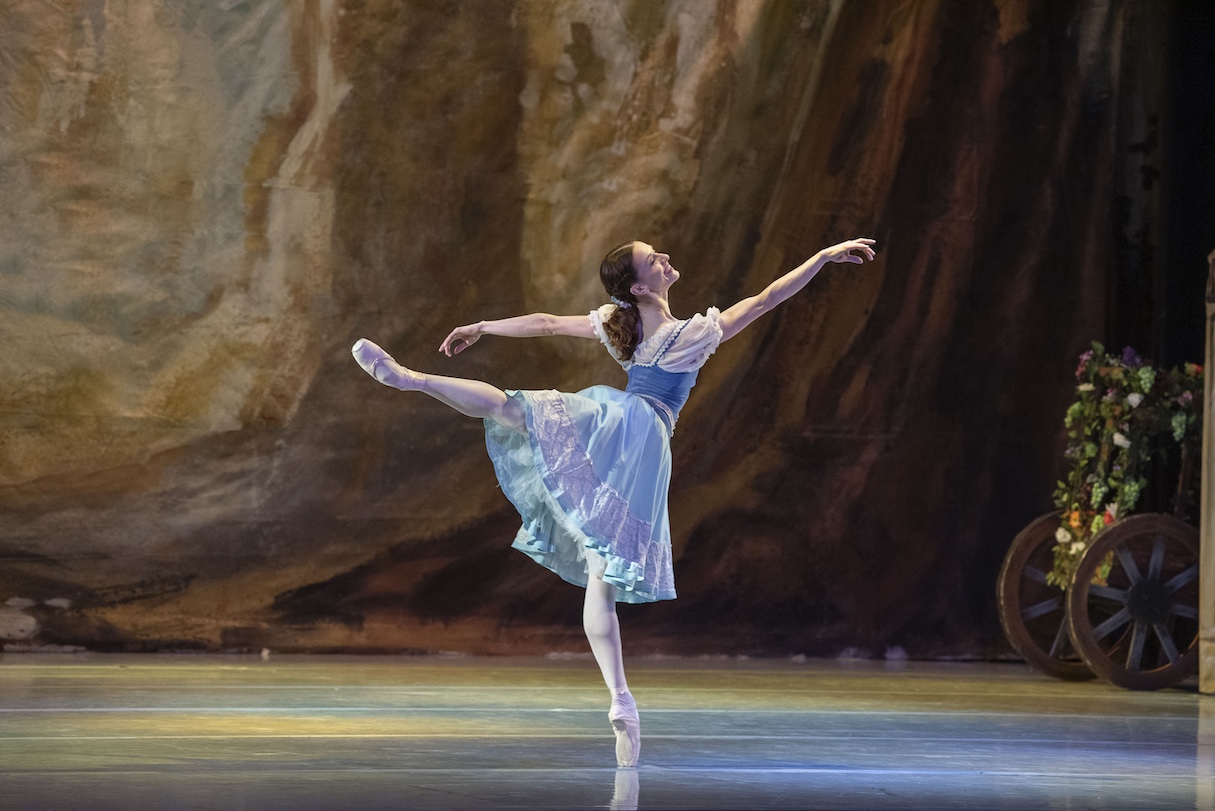
This year the Dance Committee of the ITI has selected Argentinian dancer Marianela NÚÑEZ to provide the 2024 Message (translated below from Spanish).
A memory is not enough to make history. And the history of a theatre, like that of each person, is also the history of others, of how an art like dance migrated and grew in different latitudes.
The walls of the Royal Ballet treasure photographs that narrate the journey; history calls for its protagonists, and dance in Argentina shines with each of those names. Often, institutions submerge themselves in silent anonymity, without faces or surnames, avoiding facing the echo of the past.
The organisations promoted and supported by ITI-UNESCO, such as the Argentine Dance Council, frequently act as a wall that prevents forgetfulness.
I am with you all in the commitment to rescue and revitalise the history of masters, artists and choreographers who have enriched the world of dance, deserving of being heard by future generations.
Let us all know that we are not spectators, but inheritors of a tradition forged with art, dignity and sacrifice, nourishing our path with vocation and love for beauty.
Although the future and the present capture our attention, without the solid foundation of the past, without the fertility of our land, the dance tree cannot flourish. The roots are tradition and at the same time... nutrients.
A visionary voice for dance – Hilary Trotter
Hilary Trotter, dance writer, advocate and activist
b. 13 June 1933, d. 18 February 2024
As we pay tribute to one of Ausdance's most visionary founding voices, it's appropriate to remember in some detail her contribution to the organisation and to Australian dance more widely.
Hilary and her family moved to Canberra in the 1960s, where she was dance critic for The Canberra Times from 1972–90. She was an early advocate for dance in the ACT as a writer and parent of young children at the then Bryan Lawrence School of Ballet where she herself – determined to learn the intricacies of ballet – joined the classes as an adult beginner.
In 1977 she became a founding member of the Australian Association for Dance Education (now the Australian Dance Council – Ausdance), and was its first ACT President from 1977–1981, then National President from 1981–84.
Hilary helped to draft Ausdance’s first Constitution in 1978, wrote its monthly newsletter Dance Action, managed ACT dance projects such as Sunday in the Park, and initiated the annual ACT Summer School of Dance and the ACT Dance Festival. She applied for funding to bring small dance companies in residence to Canberra, including One Extra Dance and Kinetic Energy, combining performances with workshops and discussions. She then successfully lobbied for the establishment of the ACT’s first professional dance company, Human Veins Dance Theatre (HVDT).
Funding for all Ausdance ACT projects were the direct result of Hilary’s skills as a grant application writer and advocate. In the early 1980s she was elected to the Gorman House establishment committee, ensuring that there would be workable and accessible dance spaces there with sprung floors, high ceilings and adequate office and green room spaces. Since then there have been permanent professional dance companies in residence in Gorman House Arts Centre: HVDT, the Meryl Tankard Company, Sue Healey’s Vis-à-vis Dance Canberra, the Australian Choreographic Centre, and now QL2.
Hilary toured with Australian Dance Theatre in 1982, writing a detailed diary of the company’s European tour, resulting in the publication of five chapters of Dustbins & Taffeta in Brolga 10–14. She also recorded an oral history with HVDT artistic director Don Asker, now in the National Library of Australia with Brolga – An Australian Journal About Dance. Her work as an archivist at the Australian Archives led to Ausdance's long history of recording and preserving dance.
When Ausdance National received its first Australia Council funding in 1984, Hilary became its co-director until her retirement in 1991, initiating and co-managing many projects for Ausdance National including the establishment of a national dance database, partnerships with the Media Arts & Entertainment Alliance (MEAA) to produce the Dancers’ Transition Report (1989), and the National Arts Industry Training Council to produce the first Safe Dance Report (1990) as its skilled project designer and editor, and inventing the now internationally-recognised term ‘Safe Dance’, with implications for dance practice world-wide.
Hilary's interest in design and writing led to her work on Brolga – an Australian Journal About Dance, and also Asia-Pacific Channels on behalf of the World Dance Alliance, for many years. She was the writer, editor and designer of all Ausdance National publications throughout the 1980s and 1990s, including Ausdance conference papers and Green Mill publications.
Hilary’s vision for Ausdance was to see a network of funded Ausdance organisations throughout the country, and her work to realise that vision led to real growth in Australians’ understanding of dance as an art form, as a vital part of every child’s education, as a health imperative and as a serious area of tertiary study.
The national coordinators toured the country every year throughout the 1980s and early ’90s, visiting each Ausdance office, holding meetings with companies, studio teachers, students, tertiary institutions, local arts councils and funding bodies, and endeavouring to link all their activities to meaningfully connect the industry with a voice that would be heard by decisions makers at all levels, but most particularly in the federal Parliament.
Hilary’s passing sees the end of an advocacy era, where leadership that provides action and a national overview is respected, validated and acted upon by all in the greater interest of dance across political and state boundaries. Recent national and state funding decisions have greatly undermined this effort, a situation that saddened Hilary in her later years.
Hilary’s approach was gently persuasive, always backed by written evidence and supported by others with whom she worked. Hilary was made an Honorary Life Member of Ausdance in 1991, and was further honoured at the 2018 Australian Dance Awards for Services to Dance.
– Julie Dyson, 18/2/24
Ausdance National statement to the Senate Inquiry into the National Cultural Policy
Ausdance National was invited to present at the Senate Inquiry into the National Cultural Policy in July.
Dr Cathy Adamek (Ausdance National Vice-President and Director, Ausdance ACT) attended with Michelle Silby (Director, Ausdance Victoria), presenting a two-minute response drawn from Ausdance National's submission. The response included subsequent consultation by Julie Englefield (Director, Ausdance Qld) and a review of the government's Revive policy with Jacob Williams (President, Ausdance National).
The main objective was to draw the Senate's attention to the lack of Dance references in the policy.
An excerpt of the Ausdance Public Hearing Statement reads:
- We celebrate Australia’s new National Cutural Policy Revive, and we support its broad recommendations relating to all art forms. However, there are gaps we would like to see addressed:
- There needs to be more support for First Nations dance across the sector.
- There is little reference to dance or language-specific references to dance across all pillars, which primarily emphasise visual arts and music.
- We ask that dance be explicitly recognised across the five pillars.
- Dance is a major contributor to cultural storytelling: It is
- one of the most diverse art forms, and
- one of the top three most popular forms of physical recreation.
Read the official documents:
Ausdance Public Hearing Statement
Ausdance Talking Points
Official Committee Hansard SENATE ENVIRONMENT AND COMMUNICATIONS REFERENCES COMMITTEE National Cultural Policy
Transcript of hearing
The Senators were particularly interested in the numbers associated with dance participation in Australia and dance studio issues such as music licensing.
International Young Choreographers Project 2024
Applications from emerging Australian choreographers are now being called for this international opportunity.
The IYCP has been providing young choreographers with this invaluable artistic and cultural experience since 1999. Read about previous Australian participants’ experience here.
Closing date is 16 December 2023.
About the International Young Choreographer Project
The International Young Choreographer Project (IYCP) is held in southern Taiwan in July/August and is hosted by World Dance Alliance Asia–Pacific Taiwan chapter. Eight choreographers from the Asia-Pacific region are chosen by WDA Asia Pacific (WDAAP) to attend.
Participants are selected from a list of young choreographers recommended by World Dance Alliance country chapters (Asia Pacific, including Australia, the Americas and Europe), based not only on their choreographic work, but also on their ability to meet the challenges of working in a foreign country with unfamiliar dancers and culture, and their potential as a significant contributor to dance in the future.
The selected choreographers work with selected dancers from Taiwan. The three-week process of developing new works with local Taiwanese dancers concludes with two performances. The program highlights the diversity of dance in both styles and cultures, and how local and international choreographers perceive their daily lives and the world.
Participants must fund their own travel to Taiwan. However, an honorarium of US$800 for WDAAP choreographers is included, plus accommodation, local transportation, dancers, studios, publicity, production and office assistance.
Australian applicants must be members of Ausdance (find your local Ausdance).
Information for applicants
Application forms are available from Ausdance National.
In addition to contact information, applicants will be asked to answer these questions:
- What you would gain from a professional experience such as this?
- Why would you like to work in Asia?
- A brief concept of your proposed work.
- A 200-word biography and a resume/CV.
Closing date is December 16 2023.
National Cultural Policy – a progress report
The Australian Government’s National Cultural Policy—Revive: a place for every story, a story for every place, is a 5-year plan to renew and revive Australia's arts, entertainment and cultural sectors.
Revive was launched in January this year, and the federal Office for the Arts has now provided a progress report which will continue to be updated on its site.
Revive is structured around five interconnected pillars:
- First Nations First: Recognising and respecting the crucial place of First Nations stories at the centre of Australia's arts and culture.
- A Place for Every Story: Reflecting the breadth of our stories and the contribution of all Australians as the creators of culture.
- Centrality of the Artist: Supporting the artist as worker and celebrating artists as creators.
- Strong Cultural Infrastructure: Providing support across the spectrum of institutions which sustain our arts, culture and heritage.
- Engaging the Audience: Making sure our stories connect with people at home and abroad.
This progress report updates actions on each of the five pillars that form the basis of the policy.
Annual General Meeting update
Ausdance National held its Annual General Meeting on Monday 26 June via Zoom.
The Acting Chair, Cathy Adamek, presented the Ausdance National 2022 Annual Report, and the audited accounts were presented by Treasurer Sebastien Ananian-Cooper.
Subsequent to the meeting, the AN Board met and elected the following office bearers for the forthcoming period:
- Jacob Williams (President)
- Cathy Adamek (Vice President)
- Isla Gibson (Vice President)
- Charl van der Walt (Treasurer - co-opted as per section 4.1.2 of the Constitution)
- Julie Dyson AM and Natalie Allen (board directors)
- Jane Pamenter (Public Officer: non-board position)
Ausdance National is in a period of review and transition at present, and we thank Ausdance network members and others for their contribution and input to this process with consultant Tony Grybowski.
As a result of this review, the AN board has decided to maintain the organisation to undertake a limited number of activities within its financial resources and by optimising the skills of its small Board of Directors.
In the meantime, Ausdance National is fulfilling basic governance requirements, financial management of funds and bequests, attendance at sector advocacy meetings, maintaining important lines of communication with the Ausdance network and partner relationships (Aon/NAAE/TDCA/WDA).
The review’s recommendations will be further progressed by coordinating a national gathering with members of the Ausdance network in the near future.
Updates were provided on the work of the Tertiary Dance Council of Australia, the National Advocates for Arts Education, the National Dance Forum and the Australian Dance Awards. The need for strong national advocacy for dance was also noted.
The Board acknowledged the significant contribution made over many years by Sebastian Ananian-Cooper, who stepped down at the AGM, and Lizzie Vilmanis for her contribution as Board President in 2021-22.
Thanks also to Cathy Adamek for her work as Acting Board President over the past five months.