

Principal Investigator: Shirley McKechnie
Chief Investigators: Shirley McKechnie, Robin Grove and Catherine Stevens
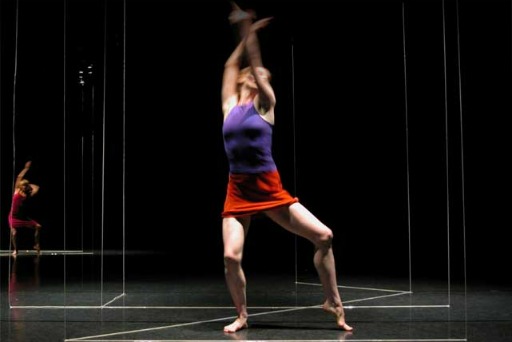 Sue Healey's Fine Line Terrain, part of the Niche series. Performer: Shona Erskin. Photo: Alejandro Roland
The research and audiences for contemporary dance
In September 2001 the Australian Research Council (ARC) announced that the Victorian College of the Arts School of Dance with its University and Industry partners had been successful in obtaining substantial funding for a major new research project.
Titled Conceiving Connections, the three-year study (2002-2005) builds on Unspoken Knowledges—the team's earlier research into choreographic practice, an investigation that focused on the nature of choreographic thought or ‘choreographic cognition’.
The new research addresses issues associated with audience development that have been identified by the dance industry as critical to its viability among the contemporary performing arts in Australia. It is seen as a significant initiative in Arts Industry related research.
In summary, the aim of the Conceiving Connections project is to investigate how audiences respond to highly evolved dance-works. We define such works as those of considerable complexity and subtlety but which do not reveal their meanings readily. The project explores the kinds of meaning communicated by such works, and the value assigned to them by tutored and untutored audiences. Methods for enhancing audience engagement are being tested through studies in both metropolitan and regional centres. Dance-scholars, artists and cognitive psychologists are collaborating with three industry partners to identify and address significant concerns for artists, presenters, advocates and funding bodies, and to train postgraduate researchers in inter-disciplinary modes.
The researchers are asking questions like these:
- What elements encourage audiences to respond to dance works with insight, pleasure and understanding?
- How do previous knowledge, experience, and information about new works affect audience responses?
- What can we discover about the relationship between cognitive, aesthetic, emotional and kinaesthetic responses to particular dance works?
Research directions
Making sense of contemporary dance
Making sense of contemporary dance: An Australian investigation into audience interpretation and enjoyment levels. A discussion of research findings by two cognitive psychologists. This short report was written at the invitation of the Australia Council for the Arts’ fuel4arts initiative, February 2005. Authors: Renee Glass & Catherine Stevens, MARCS Auditory Laboratories & School of PsychologyUniversity of Western Sydney.
The dancing mind
All in the Mind: The Dancing Mind, Radio National, Australian Broadcasting Commission (ABC) 19 March, 2005. Presenter, Natasha Mitchell, interviews three psychologists, Catherine Stevens, Patrick Haggard and Shona Erskine for an exploration of the dancing mind. Dance, she says, ‘is one of the few art forms that we make out of our own bodies, and a potent form of communication without language. Scientists, dancers and choreographers are coming together in novel ways to explore the cognitive microcosm that is this long-loved performing art’.
Research with Quantum Leap Youth Choreographic Ensemble
In a report on her progress late in 2005, PhD candidate, Shona Erskine, writes of the rationale for her research with the Quantum Leap Youth Choreographic Ensemble. A study of the relevant literature revealed huge gaps in our understanding of the process at play in, and the benefits of, dance participation. To date studies into arts participation that have involved the documentation of activities, the assessment of program strengths and weaknesses, and the tracking of individual progress have invariably been conducted using the arts as an interrelated body of subjects rather than as unique disciplines. This has served to confuse the validity of findings to specific programs and results in serious limitations to the application of the available literature to any given art form.
The findings of research have been further confounded due a lack of differentiation between curriculum based dance participation and out-of-school dance participation. The majority of research has been conducted in the school environment where art courses are bound by curriculum restraints and evaluative procedures related to academic achievement. This has in turn lead to the formation of a conceptual framework for research that focuses on the ability of the arts to inform, support, and contribute to improved academic achievement.
The consequence for the arts in justifying their existence through academic values is that the little research available does not offer a platform for the research of the unique experiences inherent in arts participation. There needs to be constructive formulation for the existence of arts programs, giving insight into the arts phenomenon as it is known, as it is actually experienced.
Participants
 The research team is chosen from the disciplines of dance, psychology, music, and interactive media, covering the various disciplines that are necessary for this project. Choreographers Anna Smith, Sue Healey, Michelle Heaven. Dancers acting as research assistants and active collaborators in the research process include, Meredith Blackburn, Brett Daffy, Jade Duffy, Shona Erskine, Michelle Heaven, Delia Silvan, Kathleen Skipp, Nicole Steven and Deidre Stewart.
Industry Partners in this research include the Australian Dance Council—Ausdance Inc, the Australia Council for the Arts and The Australian Choreographic Centre. Individual members of the team include Professor Shirley McKechnie of the VCA School of Dance; Robin Grove, The University of Melbourne; Drs Catherine Stevens and Stephen Malloch, School of Psychology/MARCS Auditory Laboratories, University of Western Sydney; and David Price of the VCA School of Film and Television. Two doctoral candidates are also working with the team; Neil Adams, choreographer, with the VCA School of Dance, and Renee Glass, cognitive psychologist, with the UWS MARCS Auditory Laboratories.
Method
From 2002 – 2004 the experimental cognitive psychologists on the team worked with dance researchers and artists to develop a valid tool that measures, in detail, the psychological responses of audience members to contemporary dance. Rather than this being a market research exercise, an attempt to find out what audiences want, we asked precise and detailed questions about the cognitive, aesthetic, and affective responses of audience members to a particular dance work. The audience participants came from a range of backgrounds, city and regional areas, and with varying expertise in dance.
The study has what psychologists call 'ecological validity', in that it was conducted in theatres with actual audiences watching a live dance performance. It also involved rigorous experimental design and measurement. For example, the effect of different types of pre-performance information sessions on response to a dance work were analysed, allowing an examination of the way background and expertise moderate the effects of such information sessions. Further Investigations have allowed the validated tool to be applied to a wider range of dance works and to differing audiences. The research project brought together researchers, artists and experts from dance and cognitive science – a truly inter-disciplinary team.
Performances of Anna Smith’s Red Rain and of Sue Healey’s Fine Line Terrain produced considerable data regarding audience responses to contemporary dance works. (Two PhD theses forthcoming) An account of the collaborative creative process that produced Red Rain includes comments from expert critics. (See Stevens, Catherine, ‘Chronology of Making a Dance: Anna Smith’s Red Rain’ pp.171-189, in Grove, R., Stevens, C., & McKechnie, S., (eds.), Thinking in Four Dimensions: Creativity and Cognition in Contemporary Dance, Melbourne University Publishing, print on demand, also electronic version including moving images, Melbourne, 2005. Sue Healey’s Fine Line Terrain is discussed by the choreographer in ‘Navigating Fine Lines’ (ibid) pp 57-80.
For the research investigations Red Rain was performed in the Studio Theatre at the VCA School of Dance, and at regional centres: the Geelong Performing Arts Centre (GPAC) in Victoria and at Earl Arts Centre, Launceston, Tasmania. Fine Line Terrain was performed at the Australian Choreographic Centre in Canberra and at the Sydney Opera House.
In 2004 the research focused on the experiential element in audience development with particular emphasis on the experiences and responses of youth audiences. Central to this phase of the research was the testing and evaluation of a nine-month ‘dance enrichment’ program at the Australian Choreographic Centre and the Sydney Opera House in 2004. Of particular interest to the researchers were (a) the development of dance literacy, appreciation and understanding in the broadest terms and (b) the impact of the intensive program on the personal and collective identity and self esteem of a group of fifty young people between the ages of 13 and 19 years. The Quantum Leap Choreographic Youth Ensemble was the focus of the research.
Filmmaker and choreographer, Sue Healey, in her role as Research Associate, was commissioned to make a documentary film to accompany the qualitative and quantitative research findings published in other media. Healey’s film, Quantum Leapers, was shown on National Television in 2005 (ABC, ‘Sunday Afternoon’). The peer-reviewed e-book Thinking in Four Dimensions: Creativity and Cognition in Contemporary Dance, edited by Robin Grove, Catherine Stevens and Shirley McKechnie, was launched by Professor Malcolm Gillies in February 2005.
Dance artists, researchers and associates of the Quantum Leap Program: Throughout 2004 the team worked with Ruth Osborne, Artistic Director of the Quantum Leap Choreographic Youth Ensemble, and with several young artist-teacher-choreographers (Sol Ulbrich, Darren Green, Jodie Farrugia, Vivienne Rogis, Paul Zivkovich). Shona Erskine, professional dancer and PhD candidate in psychology at the University of Melbourne acted as research assistant. With the cooperation and encouragement of her superviser, Dr D. Bretherton, Shona Erskine has already made significant contributions to the research. Her forthcoming thesis is provisionally titled ‘Identity Formation in the Adolescent Dancer’.
Applications
The Australia Council has committed itself to the task of shaping a "vision for the future of Australia which sees the arts playing a role that Australians see is relevant and meaningful to their lives - personally and nationally - and distinctively Australian". Among their key objectives, therefore, is to "make the arts more welcoming" and "to help Australians to find suitable entry-points to the arts."[[Australians and the Arts, Australia Council, 2001 p.33]]
Also in 2001 and similarly aware of the need to connect with audiences, Made to Move—an association of presenters committed to "developing audiences for all kinds of contemporary dance, with particular emphasis on Australian companies and Australian dance artists"[[Made to Move mission statement, "Overview of Strategic Planning", p.1]] - collated results from 2000 questionnaires, distributed at 50 performances by 12 different companies[[Ibid. p.8]]. In conjunction with Playing Australia and the Australia Council's Audience and Market Development section, Made to Move appointed Judith James Consultancy and Positive Solutions "to develop strategies to assist in the development of new audiences".
Their report emphasizes audience hunger for information and access. "The research reveals the audiences' deeply felt need for more information, and this need must be addressed now" [[Judith James Consultancy and Positive Solutions: Marketing Strategy Report. p.21.]] What is clear is that large opportunities exist for encouraging audiences to try the work of companies they do not know ("84% of participants in focus groups said they were interested in seeing work they had not previously heard about"[[Made to Move mission statement p.5]]). For Made to Move the investigations concentrated on tracking frequency of attendance, demographics, and superficial preference judgments. There is little analysis of cognitive and emotional impact, or of the depth of audiences' understanding.
At summits held by the Australian Dance Council (Ausdance) in each state and territory early in 2001 the clear message was: audience development is essential for the future of the art-form.[["Ausdance announces dance summits around Australia", February 2001 message to industry, p.2.]]The question is how such development is to be fostered. Conceiving Connections is addressing the necessary psychological issues by investigating the pattern of participant responses, and is appling this knowledge to refining information sessions and enhancement techniques.
In assessing the application for funding ARC assessors wrote
Research of this depth, as opposed to 'market analysis' is desperately needed in the arts and particularly in dance. Audience development and understanding of dance is crucial to its survival and relevance in the 21st century. Research findings from this proposal will have significant impact on the knowledge base of how and why we watch dance, and the connection between the experience of watching and doing.
Most impressive are the results and experience of the key investigators and how this project builds upon the seminal and ground-breaking research undertaken in their previous research project Unspoken Knowledges.
There is no doubt as to the national (and probably, in a globalised world, international) benefit of this research for the arts and their ongoing relevance. It is the first in-depth survey of connections between audience and performance from other than a superficial marketing type survey, or via conservative reception analysis studies.
Publications
Books
- Grove, R., Stevens, C., & McKechnie, S., (eds.), Thinking in Four Dimensions: Creativity and Cognition in Contemporary Dance, Melbourne University Publishing, print on demand vii + 211 pp., also electronic version including moving images, Melbourne, 2005
Journals and conference papers
- Adams, Neil, Visual Perception, Spatiality, and Imagery: Investigating a Paradigm for Choreographic Realisation and Appreciation, Dance Rebooted: Initialising the Grid: Publications and proceedings, Ausdance National, Canberra, 2004 (in press).
- Glass, Renee, ‘Observer Response to Contemporary Dance’, University of Western Sydney, MARCS 2003
- Grove, R. 'In the House of Breathings', in Papers and Proceedings of Australia New Zealand Dance Research Society Forum, Susan Graham (ed.) Auckland University of Technology, October 1999
- Grove, R. 'Making Ends Meet: Cultural Identities and World Dance', Sixth Annual Conference of the Korean Dance Society for the Future, Seoul, 1999
- Grove, R. 'Knowing What's Good for Us', in Papers and Proceedings of Australia New Zealand Dance Research Society Forum, Susan Graham (ed.) Auckland University of Technology, October 2001
- Grove, R. 'Unspoken Knowledges', in Lansdown, R. (ed.), The Critical Review, James Cook University, Cairns, no. 41, 2001, pp.1-10
- Grove, R. ‘A Night Out’ in Best Australian Essays of 2002, Peter Craven, (ed.) Melbourne 2003, pp. 118-129
- Grove, R. ‘A Slant of her Own; Laurel Martyn, Portrait of the Artist’ in Meanjin 62; 2, 2003, pp.188-195
- Grove, R., “Changing Directions: Mindful Bodies and Embodied Minds” in Frois, Joao Pedro, et al. (eds.) Art and Science: Proceedings of the xviii Congress of the International Association of Empirical Aesthetics, Calouste Gulbenkiian Foundation, Lisbon, September 13-16, 2004, pp. 165-168
- Heaven, M. ‘The Choreographer-Performer Collaboration’. Unpublished MA Thesis, University of Melbourne, 2000
- McKechnie, S. 'Unspoken Knowledge: Thinking in Space and Time', in Papers and Proceedings of the Conference of the Asian Pacific Confederation for Arts Education (ASPACAE) Lasalle-SIA, Singapore, July 1999
- McKechnie, S. ‘Seasons, Cycles, and Patterns in the Mind.' Occasional paper, 30th Symposium, Academy of the Humanities, Canberra, November 1999
- McKechnie, S. and Grove, R., 'Thinking Bodies: a dialogue between Robin Grove and Shirley McKechnie' in Michelle Potter (ed.) Brolga: An Australian Journal about Dance, Number 12, Ausdance, Canberra, June 2000, pp.7-14
- McKechnie, S., 'Mind in Motion: Seeking a Theory of Choreographic Cognition' In Choreography and Dance, Vol 6, Parts 2 and 3, Harwood Academic Publishers, Amsterdam, 2001, pp.139-154
- McKechnie, S. 'New Perspectives on Collaboration in the Choreographic Art' in Papers and Proceedings of Australia New Zealand Dance Research Society Forum, Susan Graham (ed.) Auckland University of Technology, October 2001
- McKechnie, S. 'Movement as Metaphor: The Construction of Meaning in the Choreographic Art', in C. Stevens, D. Burnham, G. McPherson, E. Schubert, & J. Renwick, (eds.) Proceedings of the 7th International Conference on Music Perception & Cognition, Causal Productions. Adelaide, 2002.
- McKechnie, S. ‘Nurturing the Choreographic Imagination’ Dance Educators Professional Association Conference, UNSW, Sydney, October 2002
- McKechnie, S. ‘Creativity, Cognition and the Emergence of Ideas: A dynamical Process’ University of Melbourne, Vice Chancellors Colloquium, December, 2002
- McKechnie, S. Two entries in J. Whiteoak and A. Scott-Maxwell, (eds.) Currency Companion to Music and Dance in Australia, (i)‘Choreography-Choreographers’, pp.131-136, (ii) Research and Writing- Research in Creative Arts’, pp.584-585, Currency House Inc. Sydney 2003
- McKechnie, S. ‘Disagreeable Object’ Brolga: An Australian Journal about Dance, 18/2003, Michelle Potter, (ed.) Ausdance, Canberra 2003, p.32
- McKechnie, S. ”Dance: The Dance Ensemble as a Creative System”, in Rod Wissler et al, (eds). Innovation in Australian Arts, Media and Design: Fresh Challenges for the Tertiary Sector, Post Pressed, Flaxton, Qld., 2004, pp. 13-28
- McKechnie, Shirley, ‘From Grand Narratives to Grands Changements’ in Susan Graham (ed) Australia New Zealand Dance Research Society Journal, Auckland 2004
- Stevens, C. J., & McKechnie, S. 'Composing in Space, Time, Light, and Sound: A Study in Choreographic Cognition' in International Journal of Psychology, 35, 100 (Abstract) 2000
- Stevens, C., McKechnie, S., Malloch, S., & Petocz, A. ‘Choreographic Cognition: Composing Time and Space’ in C. Woods, G. Luck, R. Brochard, F. Seddon, J. A. Sloboda & S. O’Neill (eds.) Proceedings of the 6th International Conference on Music Perception & Cogniton, Keele, UK: Department of Psychology, Keele University, August 2000.
- Stevens, C., Malloch, S., McKechnie, S. 'Moving Mind: the Cognitive Psychology of Contemporary Dance' in Brolga: An Australian Journal about Dance, Michelle Potter, (ed.) Ausdance, Canberra, No. 15, December 2001, pp.55-67
- Stevens, C., Malloch, S., Haszard Morris, R., & McKechnie, S. 'Shaped Time: A Dynamical Systems Analysis of Contemporary Dance'., in C. Stevens, D. Burnham, G. McPherson, E. Schubert & J. Renwick (eds.), Proceedings of the 7th International Conference on Music Perception & Cognition, Causal Productions. Adelaide, 2002
- Stevens, C., Malloch, S., McKechnie, S., & Steven, N. 'Choreographic Cognition: The Time-course and Phenomenology of Creating a Dance' in Pragmatics & Cognition, 11(2), John Benjamins Publishing Company, Amsterdam, 2003, pp. 299-329
- Stevens, C. (ed.) Program and Abstracts, Unspoken Knowledges: A Research Forum on Contemporary Dance and Choreographic Cognition, Melbourne International Festival, 2003
- Stevens, C. ’Conceiving Connections: Increasing Industry Viability through Analysis of Audience Responses to Dance Performance’ Partnerships in Humanities Research Symposium, UWS Sydney, February 2004
- Stevens,Catherine, & McKechnie, Shirley, “Dancing Between Worlds: Trans-disciplinary Approaches To Cognition, Creativity, and Choreography” in Frois, Joao Pedro, et al. (eds.), Art and Science: Proceedings of the xviii Congress of the International Association of Empirical Aesthetics, Calouste Gulbenkiian Foundation, Lisbon, September 13-16, 2004, pp. 161-164
- Stevens, C., & McKechnie, S. ‘Minds and motion: Dynamical Systems in Choreography, Creativity, and Dance’ in Johannes Birringer & Josephine Fenger (eds.) Tanz im Kopf: Yearbook 15 of the German Dance Research Society, LIT VERLAG Munster, 2005, pp.241-252
- Stevens, Catherine & McKechnie, Shirley, ‘Thinking in Action: Thought made visible in contemporary dance’ in Cognitive Processing, Vol. 6 no. 4 (Dec. 2005) ISSN: 1612-4782 (print version), ISSN: 1612-4790 (electronic version) Springer-Verlag GmbH, Berlin and Heidelberg, 2005, pp’243-252
Film/video, audio, screen
- Conceiving Connections Research Project: Further choreographic research (Website) Australian Dance Council (Ausdance Inc.) Canberra, 2002-2005
- Erskine, Shona, 14 x audio interviews (with transcripts) of adolescent dancers, and leaders and mentors of the Quantum Leap Youth Choreographic Ensemble, June-August, 2004. (PhD thesis, ‘Identity Formation in the Adolescent Dancer’, forthcoming)
- Glass, Renee, & Stevens Catherine, ‘Making Sense of Contemporary Dance: An Australian Investigation into Audience Interpretation and Enjoyment Levels’ published on Australia Council Website, 2005
- Healey, Sue, Fine Line, a dance film in collaboration with Shona Erskine and Victor Bramich, Sydney 2003. Premiered at Unspoken Knowledges Forum, Victorian College of the Arts, Melbourne, October 2003. (Awarded Best Dance film, Ausdance Awards 2003; Il Coreografo Elettronico (independent prize), Napolidanza, Italy 2004. Best Dance film, Reeldance Australia 2004.)
- Healey, Sue, & Pugh, Mark, Eternity, Edited Video of performance of the Quantum Leap Choreographic Youth Ensemble, Canberra Playhouse, July 2004 (For Industry Partner, Australian Choreographic Centre)
- Healey Sue, Quantum Leapers, a 23 minute Documentary Video, commissioned for the Conceiving Connections Research project in 2004. Filmmaker/Research Associate, Sue Healey. Screened on ABC TV “Sunday Afternoon”, September, 2005.
- Heaven, Michelle with Louise Curham, Installation: video footage onto hanging scrims and transparent surfaces, projections onto sphere and sculpture. Victorian College of the Arts, School of Art Gallery, December 2000, see
- McKechnie, S. (Interviewer, Audio recording) Oral History Series, 2003, Project: Conceiving Connections, Archives of the Oral History Department, National Library of Australia, Canberra. 10 audio CDs: Transcripts in progress: Sue Healey, TRC 4956/1&2, Michelle Heaven, M. TRC 4958, Margie Medlin, TRC 4957/1&2, Chrissie Parrott, TRC 4959, Hellen Sky & John McCormick, TRC 4954/1&2, Anna Smith, TRC 4955/1&2.
- Mitchell, Natasha (Interviewer and presenter) ‘The Dancing Brain’ broadcast on ABC Radio All in the Mind, 19 March 2005. Interviewees: Catherine Stevens (MARCS Auditory Laboratories, Univrersity of Western Sydney) and Patrick Haggard (University College, London) on brain imaging research: investigating mirror neuron activity in dancers as they observe dance. Shona Erskine (Dancer and PhD candidate) on the Conceiving Connections research project and her current research on the Quantum Leap Youth Choreographic Ensemble.
- Unspoken Knowledges Research Project: New choreographic research (Website) Australian Dance Council (Ausdance Inc.) Canberra 1999-2001
Performance-based exhibition of original art
- Adams, Neil ‘INCARNA in progress: performance and forum’, Victorian College of the Arts, 2003
- Adams, Neil, INCARNA, a program of three works submitted as part of PhD candidature. Featuring Delia Silvan, Phoebe Robinson, Lee Serle, Abbie Sherwood and graduating students from the Victorian College of the Arts (VCA) tertiary and secondary schools. First performance at Space 28, VCA School of Drama, December, 2005.
-
Healey, Sue, & Heaven, Michelle, Not Entirely Human (19 minute solo dance).
Music, Darrin Verhagen. First performance at the Victorian College of the Arts, 2000 - Healey, Sue, Fine Line Terrain, (55 minute ensemble work) in collaboration with Shona Erskine and Victor Bramich, Lisa Griffiths, Nelson Reguera Perez, Nalina Wait and dancers from The Aichi Arts Centre in Nagoya, Japan. Composer, Darrin Verhagen. Australian Premiere, Bangarra Studio Theatre, Sydney, 2003. )
- Smith Anna, Red Rain, (39 minute ensemble work for 7 dancers) in collaboration with Jade Duffy, Kathleen Skipp, Nicole Steven and Deidre Stewart. Music, Tan Dun. Installation, Elizabeth Boyce. First performance at Gasworks Theatre, Port Melbourne, November 1999. (Awarded the Melbourne Green Room Award for original choreography, 1999)
- Smith Anna, Quiescence, (30 minute ensemble work for 8 dancers). in collaboration with Jade Duffy, Kathleen Skipp and Deidre Stewart. Music, Arvo Part. First performance at Gasworks Theatre, Port Melbourne, August 2001 (Awarded the Melbourne Green Room Award for original choreography, 2001)